Some links below are affiliate links — if you subscribe through them, I may earn a commission at no extra cost to you. It never changes my verdict: I only recommend tools I’ve actually used, and I always tell you who each one is wrong for. Full disclosure here.
If you write fiction and you’ve spent ten minutes looking into AI tools, you’ve hit these two names: Sudowrite and Novelcrafter. They get recommended in the same breath, which is misleading — because they’re built on opposite philosophies, and the “winner” depends entirely on how you write.
I put both through the exact same test: one tense scene — a locksmith breaking into her estranged brother’s spotless, empty apartment at 2 a.m. — run through each tool with identical prompts, so I could compare the writing, the setup, and the real cost side by side. This isn’t a feature-list face-off. It’s the honest version: which one fits a drafter, which fits a series architect, which respects a tight budget, and which one you should walk away from.
A note on where I stand, because this niche deserves it: I treat AI as a writing collaborator, not a ghostwriter. Neither of these tools writes a good novel for you. Both can make the parts you find miserable — staring at a blank page, keeping a 90,000-word continuity straight — a lot less miserable. That’s the lens for everything below.
The 30-second answer
- Choose Sudowrite if you want one tool that just works out of the box, you like generating prose and brainstorming inside the writing flow, and you’d rather pay one predictable bill than wire up an AI provider yourself. Best for drafters, pantsers, and anyone who finds setup tedious.
- Choose Novelcrafter if you write series, you care about a deep, structured “story bible,” you want to choose your own AI model (and often pay less for the AI itself), and you don’t mind a steeper setup. Best for plotters, worldbuilders, and control-minded power users.
Now the detail that actually justifies the click.
The core difference: all-in-one vs bring-your-own-key
This is the whole ballgame, so it goes first.
Sudowrite is all-in-one. Your subscription includes the AI. It runs on Sudowrite’s own in-house fiction model, Muse, which is trained specifically on fiction rather than general text. You pay one price, you get a monthly pool of credits, and every feature draws from that pool. Nothing else to configure.
Novelcrafter is bring-your-own-key (BYOK). Your subscription pays for the platform — the editor, the Codex, the organizational muscle — but the AI is not included. You connect your own API key from a provider like OpenAI, Anthropic, or OpenRouter, and you pay that provider separately for the words you generate. (Novelcrafter’s cheapest tier, Scribe, includes no AI at all — it’s a manual writing-and-organization workspace.)
Why this matters before you even compare features: it changes what “the price” means, who’s a fit, and how much control you have. When I set them up, this difference was immediate — Sudowrite had me writing in seconds, while Novelcrafter took me 5–10 minutes to connect an OpenRouter key and fund it before I could generate a single word.
Pricing, honestly
Here’s where the BYOK distinction stops being abstract.
| Sudowrite | Novelcrafter | |
|---|---|---|
| Entry price | $10/mo (Hobby & Student, billed annually) / $19 monthly | $4/mo (Scribe — no AI) |
| “Real” working tier | $22/mo (Professional, annual) / $29 monthly | $8/mo (Hobbyist — adds BYOK AI) |
| Top tier | $44/mo (Max, annual) / $59 monthly | $14–$20/mo (Artisan / Specialist) |
| AI included in price? | Yes — Muse, via monthly credits | No — you pay your own API provider separately |
| Free trial | Yes, no card (limited credits) | 21 days, all features, no card |
| Annual discount | Up to ~50% off vs monthly | 2 months free |
Prices are in USD and were verified against each company’s own pricing page on 1 July 2026. Sudowrite bills in USD; Novelcrafter localizes prices to your region, so you may see your local currency. Both change over time — re-check before you rely on these.
The trap in the headline numbers: Novelcrafter’s $8/mo looks dramatically cheaper than Sudowrite’s $22/mo, and for a light user it genuinely can be. But add your API costs and the gap narrows — sometimes a little, sometimes a lot, depending on which model you pick and how much you generate.
Here’s what my own test actually cost. I ran the same ~390-word scene through each. In Novelcrafter (using GPT-4o through OpenRouter) the generation used 834 tokens and cost about $0.006 — barely half a cent. In Sudowrite, two Write generations drew roughly 1,488 credits total (~744 each) from the trial pool. On Sudowrite’s Professional plan (1,000,000 credits a month) that’s a rounding error — hundreds of scenes’ worth. So the real picture: Novelcrafter’s raw AI cost per generation is tiny, but you’re funding and watching a separate API bill; Sudowrite’s credits feel effectively all-you-can-eat at the Pro tier, with nothing else to manage.
The honest takeaway: Sudowrite wins on predictability; Novelcrafter wins on floor price and ceiling control. Don’t let the $8 vs $22 line fool a reader into thinking it’s settled.
Feature-by-feature
| Capability | Sudowrite | Novelcrafter |
|---|---|---|
| AI model | In-house Muse, trained on fiction | Any model you connect (OpenAI, Anthropic, OpenRouter, etc.) |
| Story bible / world tracking | Story Bible — idea → outline → chapter beats → prose | Codex — characters, locations, lore with automatic tracking |
| Best-known strength | Generating prose & ideas in the flow (Write, Brainstorm, Describe, Expand) | Organizing long, multi-book continuity; model flexibility |
| Drafting tools | Write (continues in your voice), Expand, Rewrite, Describe | Generate-from-scene-beats; manual-first editor with AI on tap |
| Series / multi-book support | Yes, via Story Bible | Strong — Series & Universes are core to the design |
| Setup friction | Minimal — sign in and write | Higher — connect an API key, fund it, pick a model |
| Learning curve | Gentle | Steeper, more rewarding for power users |
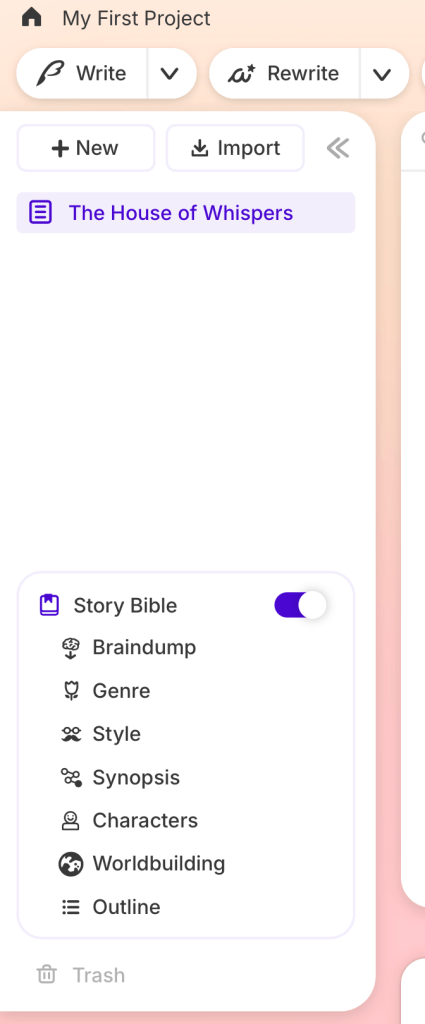
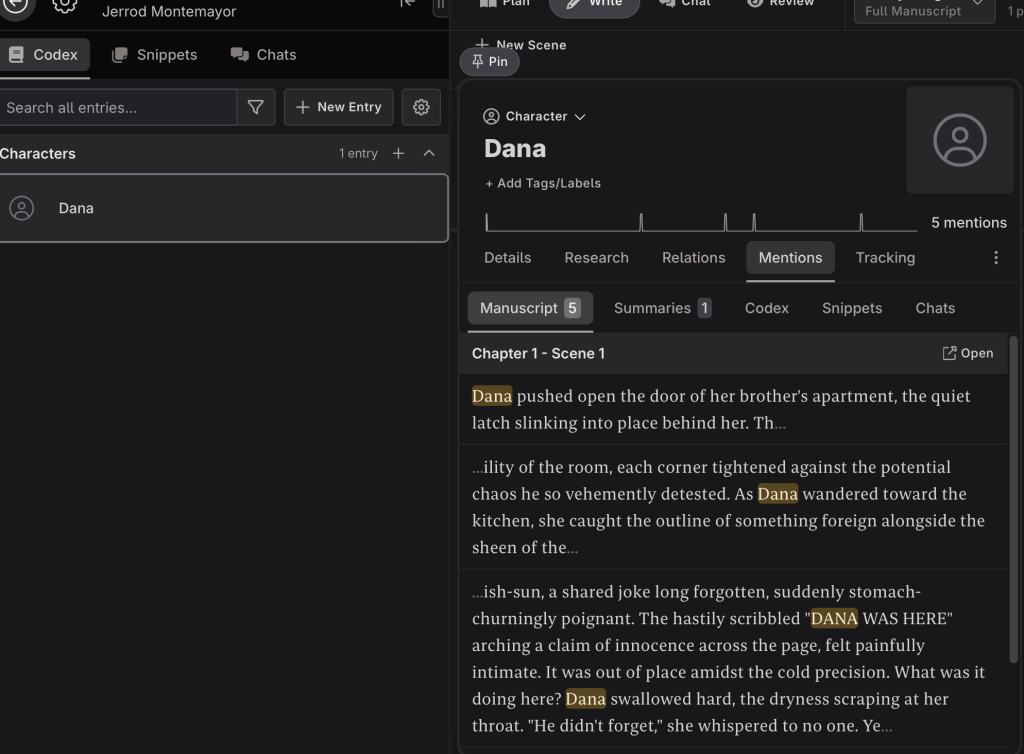
I checked these hands-on. Sudowrite’s Story Bible genuinely walks you from Braindump → Genre → Style → Synopsis → Characters → Worldbuilding → Outline, so the scaffolding is there before you write a word. Novelcrafter’s Codex started auto-tracking my character the instant I added her — it flagged 5 mentions across the generated prose with zero manual tagging.
A few honest observations from actually running both:
- Sudowrite’s Describe is the quiet standout — I highlighted a phrase and it handed back sensory options I’d actually use, not filler. Genuinely helpful for prose that’s gone flat.
- Novelcrafter’s Codex auto-tracking is the real thing — add a character and it immediately starts counting and linking mentions. You can feel how that pays off across a long series, when you genuinely can’t remember which side character had the limp.
- Here’s the surprise: Sudowrite markets Muse as the fiction specialist, but in my quick same-scene test its output read a little more generic to me than the GPT-4o draft I got through Novelcrafter. One informal test isn’t a verdict — but it’s a good reminder to try both yourself instead of trusting the label.
Honest pros and cons
Sudowrite
Pros
- Zero setup. The AI is included; you start writing immediately. (In my testing, sign-in to first words took seconds — no card, no key.)
- The interface is genuinely beginner-friendly — clean, almost addictive, understandable at a glance.
- Strong “in the flow” tools (Write, Brainstorm, Describe, Expand) that fit how drafters actually work.
- Predictable single bill — no surprise API charges.
Cons
- More expensive at the entry point than Novelcrafter’s platform fee.
- The free trial credits are limited and can run dry mid-project (mine did).
- You’re locked to Muse — you can’t swap in a different model, and in my quick test Muse didn’t clearly out-write a general model.
Sudowrite is the wrong tool for: budget-first writers who only use AI lightly (you’ll overpay for credits you don’t burn), and control-minded users who want to choose and switch models. If “I want to run the newest model myself” is your instinct, you’ll feel boxed in.
Want to feel the difference rather than take my word for it? Sudowrite’s free trial lets you start with no credit card. Start your free Sudowrite trial here.
Novelcrafter
Pros
- Very low platform price (from $4/mo; $8/mo to unlock BYOK AI).
- Model freedom — connect whatever AI you want and switch as the field moves. (I ran GPT-4o via OpenRouter and it read like real fiction.)
- Codex is best-in-class for series and worldbuilding continuity — the auto-tracking is real.
- You only pay for the AI you actually use — my ~390-word test scene cost about half a cent.
Cons
- BYOK setup is a real hurdle — it took me 5–10 minutes as a newcomer to connect an API key and fund a provider before I could generate anything.
- Having to pay a separate provider at all is a psychological barrier that will put some writers off (it nagged at me a little too).
- The cheapest tier has no AI at all, which surprises people.
- Less hand-holding; it’s powerful but it feels a bit like homework.
Novelcrafter is the wrong tool for: writers who want to push one button and get prose, anyone allergic to setup, and people who’d rather not think about which model they’re using. If reading the phrase “connect your API key” made you tired, this isn’t your tool.
If model control and a deep story bible sound like you, Novelcrafter has a 21-day free trial with every feature unlocked. Start your free Novelcrafter trial here. (Heads-up: to generate with AI you’ll connect your own provider key — budget a few dollars for that on top.)
So which one wins?
Neither “wins” in the abstract, and any review that crowns one without asking how you write is selling you something. Here’s the matchup by writer type:
- You’re a drafter / pantser who wants momentum: Sudowrite. The included model and in-flow tools keep you in the writing instead of the settings.
- You’re a plotter writing a series or a big secondary world: Novelcrafter. Codex is the reason, and model freedom is the bonus.
- You’re on a tight budget and use AI lightly: Novelcrafter (low platform fee + pay-as-you-go AI).
- You’re a heavy generator who hates surprises on a bill: Sudowrite (one predictable price).
- You’re non-technical and want it to just work: Sudowrite.
- You want to run the newest model the week it ships: Novelcrafter.
My honest recommendation: try both free. Draft the same scene in each and you’ll know within an afternoon which one fits. For what it’s worth, here’s how it shook out for me — Novelcrafter felt more like a true creative collaborator, but also more like homework, with the setup and API-key management that comes with it. Sudowrite felt effortless from the first click. So if you want to start writing simply and today, I’d point you to Sudowrite; if you want depth and control and don’t mind the extra work, Novelcrafter rewards it.
Still deciding? Start with Sudowrite if you want to write today with zero setup, or reach for Novelcrafter if control and continuity are what’s been holding your series back. There’s no wrong first step — both have free trials.
FAQ
Is Sudowrite or Novelcrafter better for beginners?
Sudowrite, easily. Signing in and writing took seconds — no card, no setup — and the interface is so clean that, in my testing, anybody could figure it out at a glance. Novelcrafter makes you connect your own AI key first, which took me 5–10 minutes as a newcomer and means funding a separate provider — a real hurdle if you’re not technical.
Does Novelcrafter include the AI in its price?
No. Novelcrafter charges for the platform; you connect and pay your own AI provider (OpenAI, Anthropic, OpenRouter, etc.) separately. The Scribe tier has no AI at all.
Can I use both?
Plenty of writers do — Novelcrafter’s Codex to organize a series, Sudowrite to generate and polish prose. If your budget allows, there’s no rule against running both.
Which is cheaper?
Novelcrafter’s platform fee is lower, and the raw AI cost can be tiny — my test scene ran about half a cent. But you’re managing a separate API bill, and heavy users can pay more than they expect. Sudowrite’s credits are predictable and generous at the Pro tier. Light users usually pay less with Novelcrafter; heavy generators often prefer Sudowrite’s flat credits.
About the author. Jerrod Montemayor is an indie author who writes and self-publishes his own fiction. He tests AI writing tools on real manuscripts before recommending them, and writes about them like a fellow writer — including the parts that don’t work and who each tool is wrong for. More about Jerrod →
 The Novelist's Stack
Leave a comment